COURTLY LOVE AND THE LOST ART OF DEVOTION
- Aurora Roseline J. Lane, PhD

- Feb 24
- 4 min read
A Jungian and Hermetic Reflection on Medieval Eros and Modern Disconnection
In the medieval world, love was not understood primarily as a private emotion. It functioned as a discipline, a path of refinement, and a formative education of the soul. Courtly love, emerging in the twelfth century in regions of what is now southern France, particularly Provence and Aquitaine, carried a symbolic grammar that shaped desire into something transformative rather than impulsive. Through ritualized restraint, imaginative devotion, and ethical obligation, lovers engaged in an inward practice that revealed truths about longing, identity, and the nature of the psyche.
While the language of this tradition is historical, the psychological structures beneath it remain active. As Carl Jung observed, archetypes do not vanish with time; they change expression. The patterns encoded in courtly love reappear in modern experiences of attachment, projection, and the longing for meaningful union. Yet something essential has been lost. The cultural frameworks that once supported depth and symbolic containment have eroded, leaving many navigating intimacy in a climate of immediacy and fragmentation.
At the heart of the courtly tradition stood the troubadours. These poet-musicians were not merely entertainers but intellectual and philosophical figures who articulated a refined vision of Eros. Writing and performing in Occitan, they composed lyric poetry that explored longing, restraint, fidelity, and the transformative power of desire. Their songs carried metaphysical insight beneath their melodies. Troubadour culture treated music as an educative force, capable of shaping character, cultivating virtue, and refining emotional life. Beauty, in this context, was not decorative but formative.
In their work, devotion became an art form that blended poetry, music, and contemplative psychology. Troubadour song functioned as a vessel that could hold tension without resolution, allowing longing to be endured rather than discharged. In this way, desire was elevated from instinct to symbol, from impulse to inner labor.
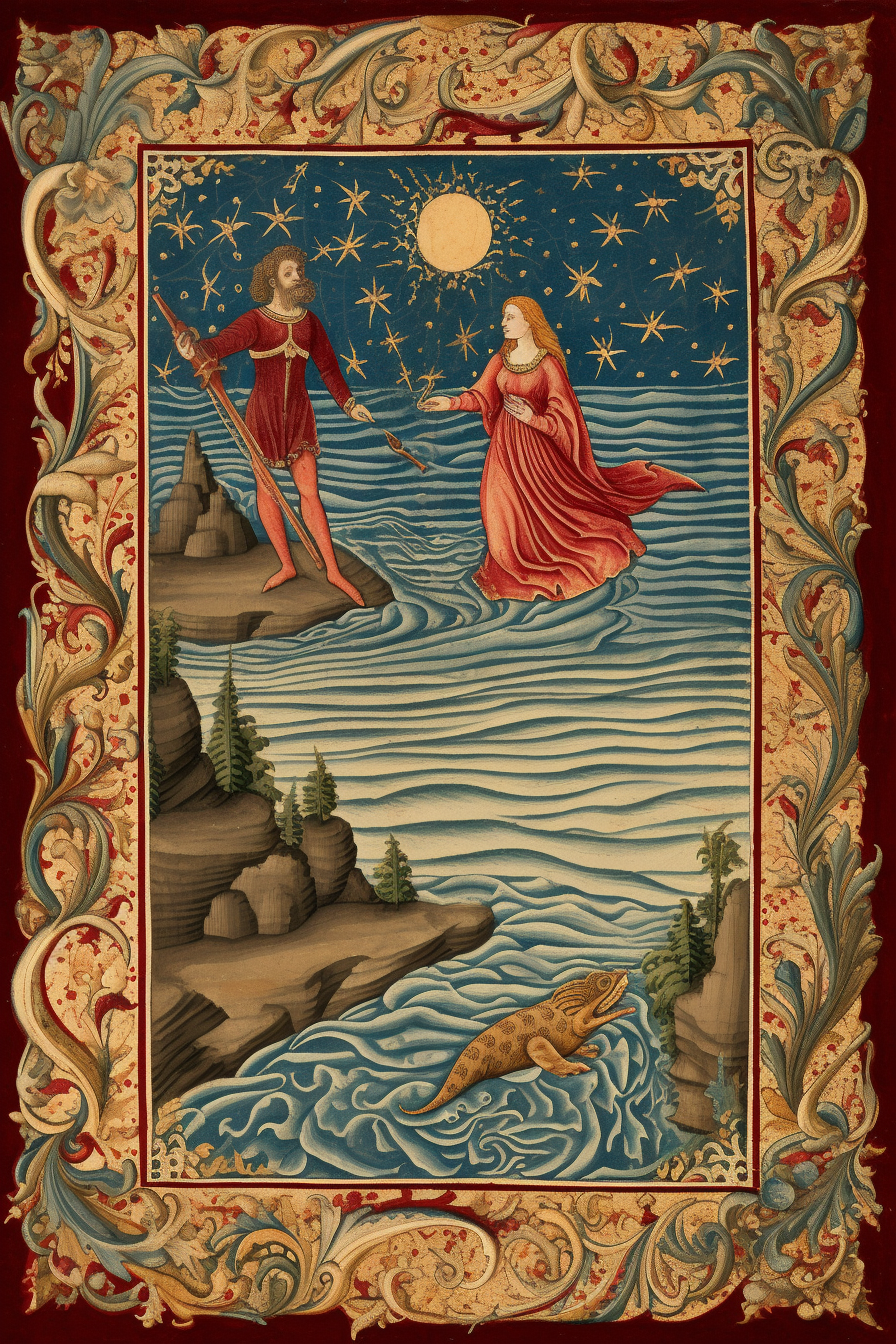
Courtly love developed alongside this musical and poetic tradition. The beloved figure, often idealized and socially unattainable, generated the tension required for psychological transformation. Distance was not a failure of love but its condition. The lover endured longing as a form of initiation. Through this discipline, qualities such as patience, imagination, humility, and ethical restraint were cultivated. Devotion was not a display but a training of consciousness.
This refinement was intentional. Eros was understood as an educating force rather than a purely consumptive one. In Jungian terms, the beloved constellated the anima or animus within the lover, awakening latent psychological potentials. Courtly love did not aim at possession. It aimed at inner expansion. Longing, when properly contained, became a psychic fire capable of reshaping the individual.
Contemporaneous with this tradition, the Cathars of southern France articulated a more explicitly mystical worldview. Their theology framed union not merely as relational but as ontological. Love revealed the eternal nature of the soul rather than securing comfort within the material world. Ethical purity, intention, and refinement of consciousness were prerequisites for authentic union. Though distinct from courtly love, Cathar spirituality shared its emphasis on discipline, inward transformation, and the rejection of purely instinctual gratification. Love, in this view, was a path rather than a sentiment.
Jung later articulated a psychologically analogous insight through his concept of the inner marriage. Relationships become unstable, he suggested, when individuals unconsciously assign their disowned qualities to partners. The anima and animus function as symbolic mediators, drawing consciousness toward wholeness. Without inner integration, outer relationships become arenas for unconscious conflict. The medieval world, for all its limitations, attempted to structure intimacy around reverence, containment, and symbolic meaning rather than collapse into impulse.
Alchemy expressed this same process symbolically through the image of hieros gamos, the sacred marriage of opposites. In alchemical texts, the union of sun and moon within the sealed vessel produced transformation. This was never merely a physical event but a psychic one. Hieros gamos signified the integration of clarity and depth, spirit and matter, activity and receptivity. When activated internally, it produced coherence and insight. When mirrored relationally, it generated bonds experienced as both spiritual and profoundly human.
The figures of Mary Magdalene and Yeshua have often been interpreted through this symbolic lens within Western esoteric and psychological traditions. Whether understood historically, theologically, or imaginally, their pairing represents a union of complementary inner qualities rather than a literal romantic narrative. Magdalene has long been associated with wisdom, presence, and spiritual interiority, while Yeshua symbolizes orientation, compassion, and transformation. Together, they express an archetype of balanced eros, in which devotion becomes revelatory rather than sentimental. Their symbolic union reflects a harmony many traditions associate with the deeper purpose of relationship: the refinement of the soul.

Much of this symbolic infrastructure has faded in modern culture. Relationships form rapidly and dissolve without initiation or meaningful closure. Digital environments privilege immediacy over intention. Communal frameworks that once supported symbolic depth have largely disappeared. Without shared rituals or ethical containment, eros loses its vessel. The psyche continues to long for meaning, yet the cultural means for cultivating devotion have thinned.
The result is relational fragility. Modern individuals are not less capable of love than their medieval counterparts. They are deprived of the symbolic contexts that once shaped longing into maturation. Courtly love demanded discipline. Contemporary love often demands little. When nothing is required, little is transformed.
Alchemy reminds us that heat without a vessel dissipates. Courtly love functioned as such a vessel. The Cathar vision provided another. The troubadours, through their devotion to shaping longing with music and poetry, offered yet another. The mythic image of hieros gamos served the same purpose. These systems affirmed that longing has meaning, that love refines rather than weakens, and that devotion is a form of mastery rather than submission.
Recovering this lost art does not require a return to medieval social structures. It requires remembering the psychological truths embedded within them. Relationships deepen when approached with reverence. Longing becomes instructive when allowed to teach rather than overwhelm. Union transforms when understood as an encounter between two interior worlds rather than two egos.
The psyche still recognizes this older way of loving. It responds to discipline, imagination, and symbolic literacy. It seeks unions that strengthen rather than consume. Courtly love and the mystic traditions surrounding it endure because they articulate something timeless. To love well is not merely to feel, but to undergo a process that reveals who we are and who we may yet become.


Comments